



Texts from a Transitional Period: Writing, Language Transmission, and Inscription Structure
Transitional writing traditions make it possible to study not only changes in the shapes of signs, but also the practical purposes for which writing was used: training scribes, transmitting linguistic knowledge, recording personal names, legal instructions, and commemorative information. Materials in which different languages, writing systems, or graphic traditions coexist are particularly revealing.
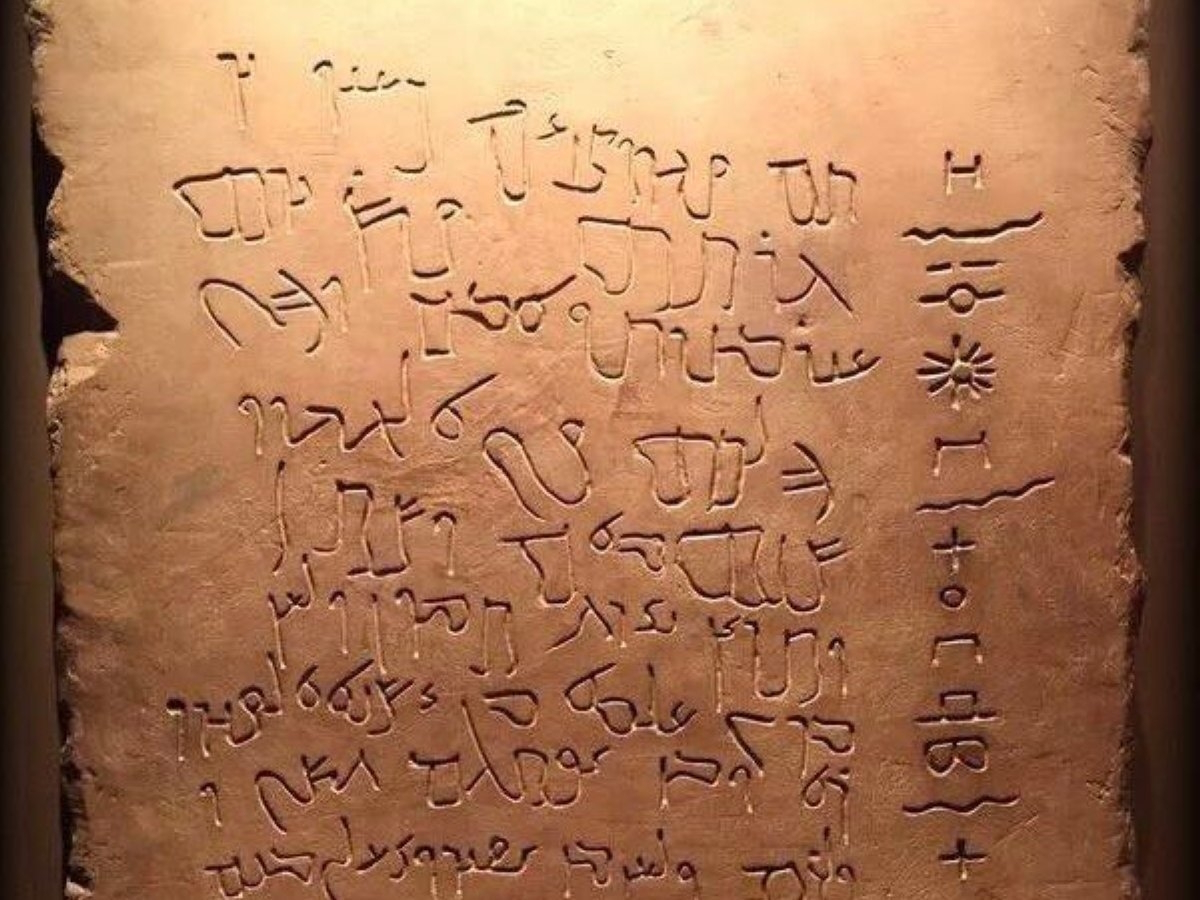
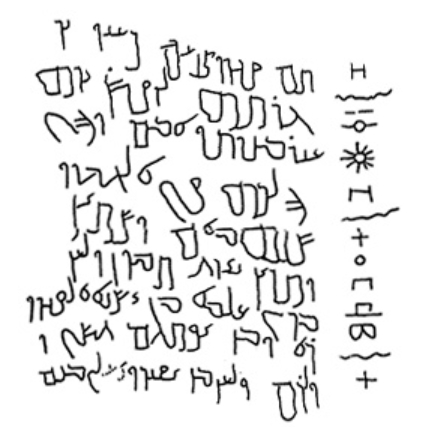
This article examines three groups of materials: Sumerian-Akkadian lexical lists, inscriptions from Alakan, and the Raqush inscription from al-Hijr. They belong to different historical contexts, yet together illustrate several important aspects of written culture: learning to use signs, the coexistence of writing traditions, and the use of graphic means to record texts.
1. Sumerian-Akkadian Lexical Lists: Learning to Write in a Multilingual Environment
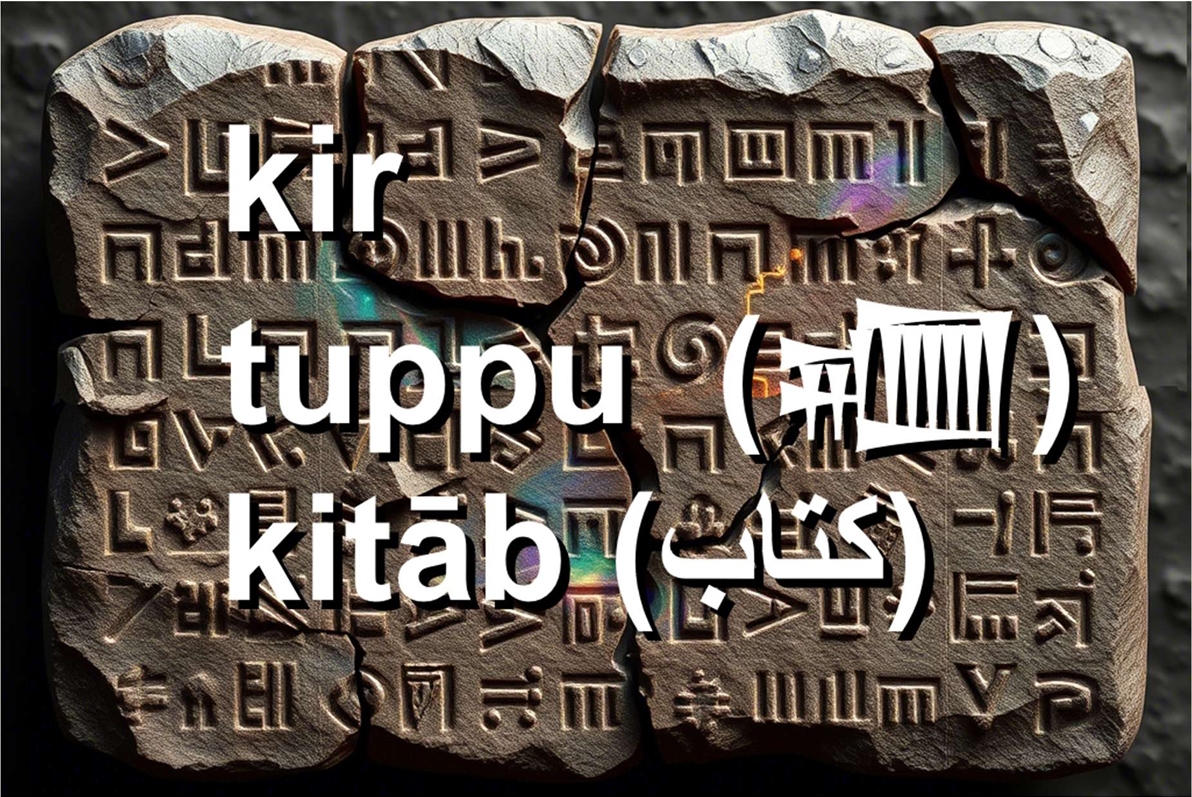
Sumerian-Akkadian lexical lists are tablets on which words, signs, or groups of words were arranged in a particular order. Depending on the type of list, they could contain thematic groups of objects, lists of professions, cuneiform signs, Sumerian words, and their Akkadian equivalents.
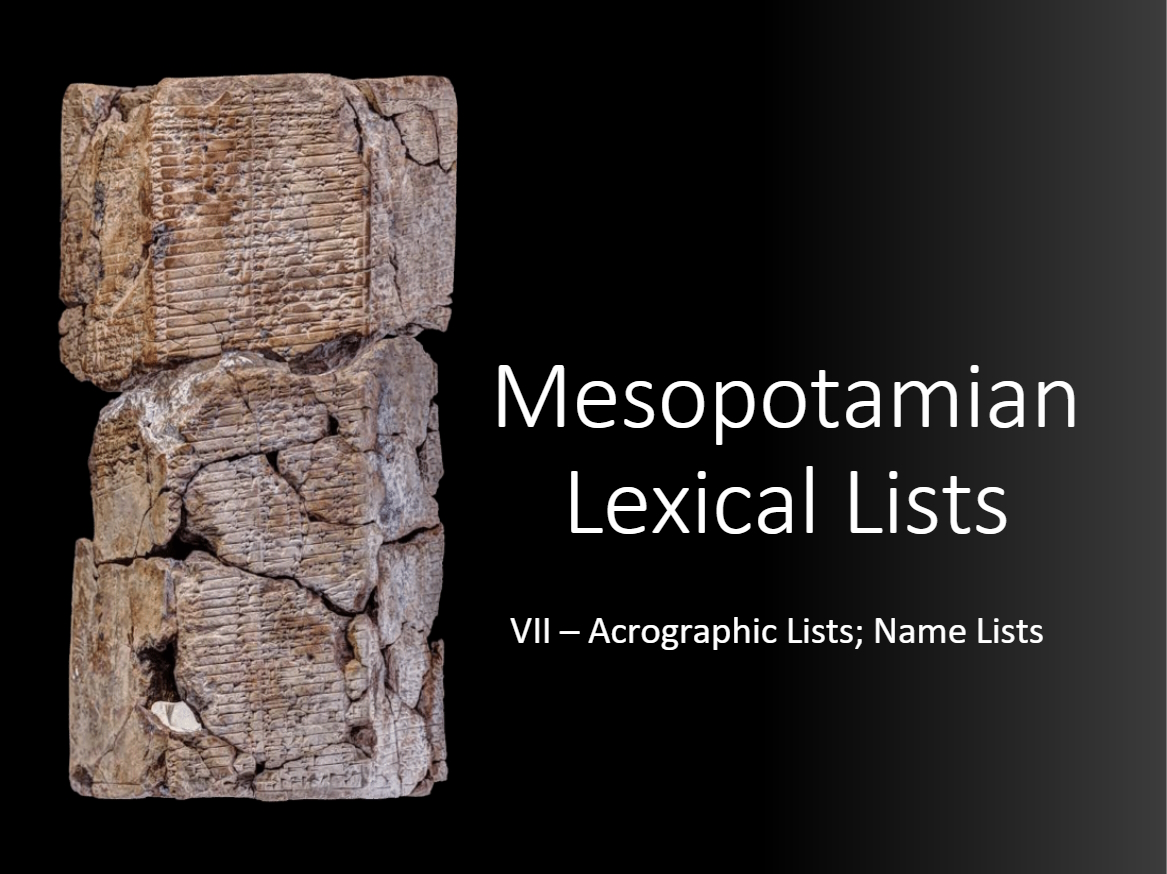
Such lists existed for thousands of years. Their functions changed over time: early lists were associated with the development and transmission of writing practices, while later lexical series became an important part of systematic scribal education and the preservation of traditional knowledge.
Why were bilingual lists needed?
Sumerian and Akkadian were different languages, but both were written in cuneiform. The same sign could have several uses, and the rules governing signs in Sumerian and Akkadian differed considerably. Thus, literacy was not simply a matter of memorizing the outward form of a sign: it also required learning its function in a particular language, how words were read, and the relationship between written form and linguistic content.
During the third millennium BCE, Akkadian became widely used alongside Sumerian. Later, Sumerian gradually ceased to be a spoken language, but continued to be used in written, cultic, and scholarly traditions. This created a practical need to train scribes living in an Akkadian-speaking environment to read and reproduce Sumerian texts.
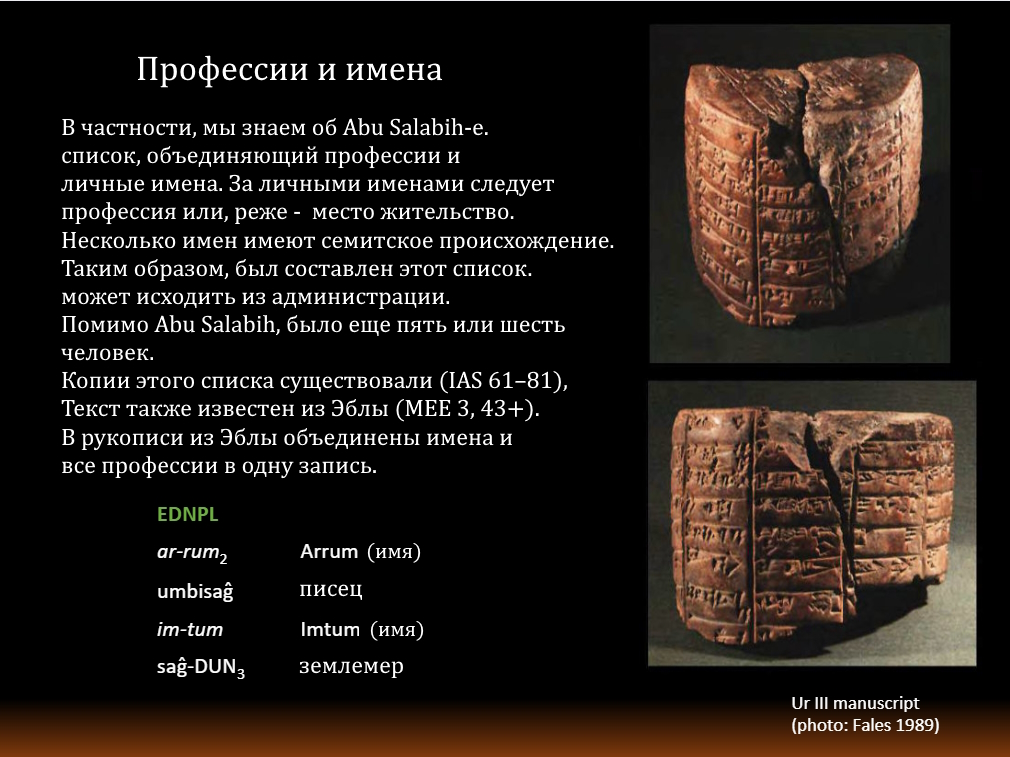
- The student learned the shapes of signs and how to reproduce them.
- Next, the student studied vocabulary and the rules for using signs in Sumerian words.
- To aid comprehension, Sumerian words could be explained in Akkadian.
- In later bilingual lists, Akkadian equivalents were written alongside Sumerian forms.
An important detail is that an Akkadian translation was not necessarily present on the tablet itself. In Old Babylonian teaching practice, Sumerian words could be explained orally, whereas later lists increasingly recorded Akkadian equivalents in writing. Therefore, the absence of a translation in a particular list does not mean that linguistic explanation was not used in teaching.
Malku = Šarru: A Lexical Reference Work and the Institutional Support of Knowledge
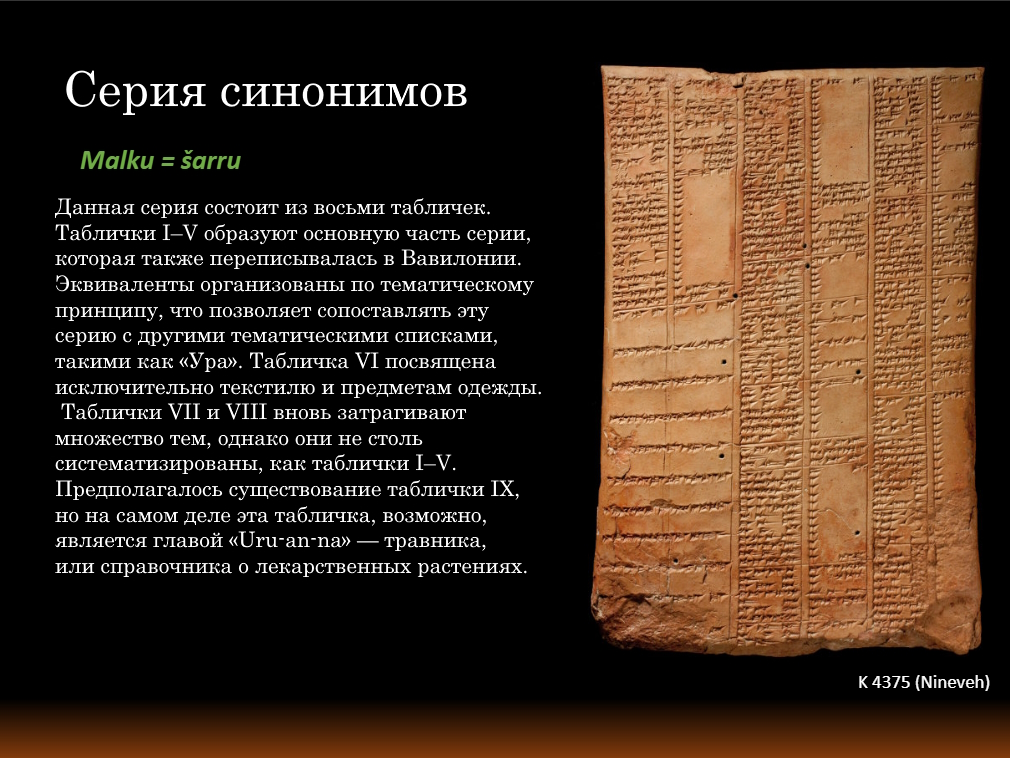
The Malku = Šarru series is an Akkadian lexical reference work comprising eight tablets.
Mesopotamian Lexical Lists XIII: Synonym ListsMalku = Šarru: A Lexical Reference Work and the Institutional Support of Knowledge
The Malku = Šarru series is an Akkadian lexical reference work comprising eight tablets. The first five form the core of the series; the sixth is devoted to textiles and clothing; and the seventh and eighth cover additional thematic groups. The series is also known from Babylonian copies.
The title itself deserves particular attention. Akkadian malku is equated with šarru, meaning “king” or “ruler.” The consonantal root M-L-K has close parallels in other Semitic languages: Arabic malik (مَلِك), Hebrew meleḵ (מֶלֶךְ), and Ugaritic mlk. In all these cases, the term is associated with kingship and rule.
What might the title Malku = Šarru mean?
At the lexical level, the title juxtaposes two Akkadian terms denoting a ruler. However, the fact that this formula became the traditional title of an extensive lexical series raises an additional question: might it reflect not only a semantic equivalence between words, but also the institutional environment in which the reference work was produced and used?
The scale of the work should also be taken into account. Creating eight tablets of systematically organized lexical material would have required considerable time, professional scribal training, and an organized process for copying and preserving the texts. Such an undertaking was unlikely to have been limited to an isolated individual initiative.
Possible links with royal administration
The compilation and reproduction of such reference works presupposed material and organizational resources. Scribe training, tablet production, the copying of large volumes of text, and the transmission of written knowledge across generations could have been supported by institutions with the necessary resources.
It is therefore possible to hypothesize that such lexical projects were supported by major institutional structures, including palace administration. The royal household could have been one source of funding and organizational support. In other words, the systematization of written knowledge may have formed part of the state's broader administrative infrastructure.
In this context, the juxtaposition of Malku and Šarru becomes especially interesting. It raises the question of whether the series' traditional title reflects a particular relationship between lexical systematization and royal power—from a simple designation of a ruler to a possible institutional association of the reference work itself.
Research conclusion
Mesopotamian lexical series should be viewed not merely as collections of words and equivalents, but also as products of organized efforts to classify, standardize, and transmit written knowledge. Their scale, thematic structure, and repeated copying point to a stable tradition of professional textual work.
Perhaps the creation of such reference works was driven not only by scribal training needs, but also by a broader administrative demand for standardized knowledge. In that case, lexical series could have served educational, reference, and institutional functions simultaneously, supporting both written culture and administrative structures.
The hypothesis of royal funding remains open to further investigation. To substantiate it, one would need to examine tablet colophons, information about scribes, the archival provenance of copies, and the circumstances of their production. The title Malku = Šarru does not in itself prove a royal commission, but it does raise the question of a possible connection between the production of lexical knowledge and the resources of state power.
The first five tablets form the core of the series; the sixth is devoted to textiles and clothing; and the seventh and eighth cover additional thematic groups. The series is also known from Babylonian copies.
The title itself deserves particular attention. Akkadian malku is equated with šarru, meaning “king” or “ruler.” The consonantal root M-L-K has close parallels in other Semitic languages: Arabic malik (مَلِك), Hebrew meleḵ (מֶלֶךְ), and Ugaritic mlk. In all these cases, the term is associated with kingship and rule.
What might the title Malku = Šarru mean?
At the lexical level, the title juxtaposes two Akkadian terms denoting a ruler. However, the fact that this formula became the traditional title of an extensive lexical series raises an additional question: might it reflect not only a semantic equivalence between words, but also the institutional environment in which the reference work was produced and used?
The scale of the work should also be taken into account. Creating eight tablets of systematically organized lexical material would have required considerable time, professional scribal training, and an organized process for copying and preserving the texts. Such an undertaking was unlikely to have been limited to an isolated individual initiative.
Possible links with royal administration
The compilation and reproduction of such reference works presupposed material and organizational resources. Scribe training, tablet production, the copying of large volumes of text, and the transmission of written knowledge across generations could have been supported by institutions with the necessary resources.
It is therefore possible to hypothesize that such lexical projects were supported by major institutional structures, including palace administration. The royal household could have been one source of funding and organizational support. In other words, the systematization of written knowledge may have formed part of the state's broader administrative infrastructure.
In this context, the juxtaposition of Malku and Šarru becomes especially interesting. It raises the question of whether the series' traditional title reflects a particular relationship between lexical systematization and royal power—from a simple designation of a ruler to a possible institutional association of the reference work itself.
Research conclusion
Mesopotamian lexical series should be viewed not merely as collections of words and equivalents, but also as products of organized efforts to classify, standardize, and transmit written knowledge. Their scale, thematic structure, and repeated copying point to a stable tradition of professional textual work.
Perhaps the creation of such reference works was driven not only by scribal training needs, but also by a broader administrative demand for standardized knowledge. In that case, lexical series could have served educational, reference, and institutional functions simultaneously, supporting both written culture and administrative structures.
The hypothesis of royal funding remains open to further investigation. To substantiate it, one would need to examine tablet colophons, information about scribes, the archival provenance of copies, and the circumstances of their production. The title Malku = Šarru does not in itself prove a royal commission, but it does raise the question of a possible connection between the production of lexical knowledge and the resources of state power.
What does this tell us about the organization of education?
The existence of such materials points to the need to distinguish at least two competencies: command of a language and command of a written tradition. A person could speak Akkadian without being able to read a cuneiform text in Sumerian. Working with such a text required specialized training.
Sumerian-Akkadian lists can therefore be viewed as teaching tools that connected a language already familiar to the student with the signs, words, and texts being learned. They helped transmit writing skills across generations and supported work with a language that was no longer spoken in everyday life.
Lexical lists were not an unchanging document type. Their content and purpose depended on the period: early thematic lists, Old Babylonian school exercises, and later scholarly lexical series could serve different functions. Each list should therefore be considered in light of its structure and context.
Sources for further study: Digital Corpus of Cuneiform Lexical Texts — Introduction: What is a Lexical List?; DCCLT — The Old Babylonian Period; DCCLT — Introduction to Cuneiform Sign Lists.
2. Inscriptions from Alakan: The Coexistence of Graphic Traditions
The inscriptions from Alakan are of interest for the study of writing practices on the Arabian Peninsula in Late Antiquity. In particular, the writing convention designated Thamudic D is compared with Nabataean-Arabic writing. Their comparison makes it possible to consider how messages of similar content could be recorded in different graphic traditions.
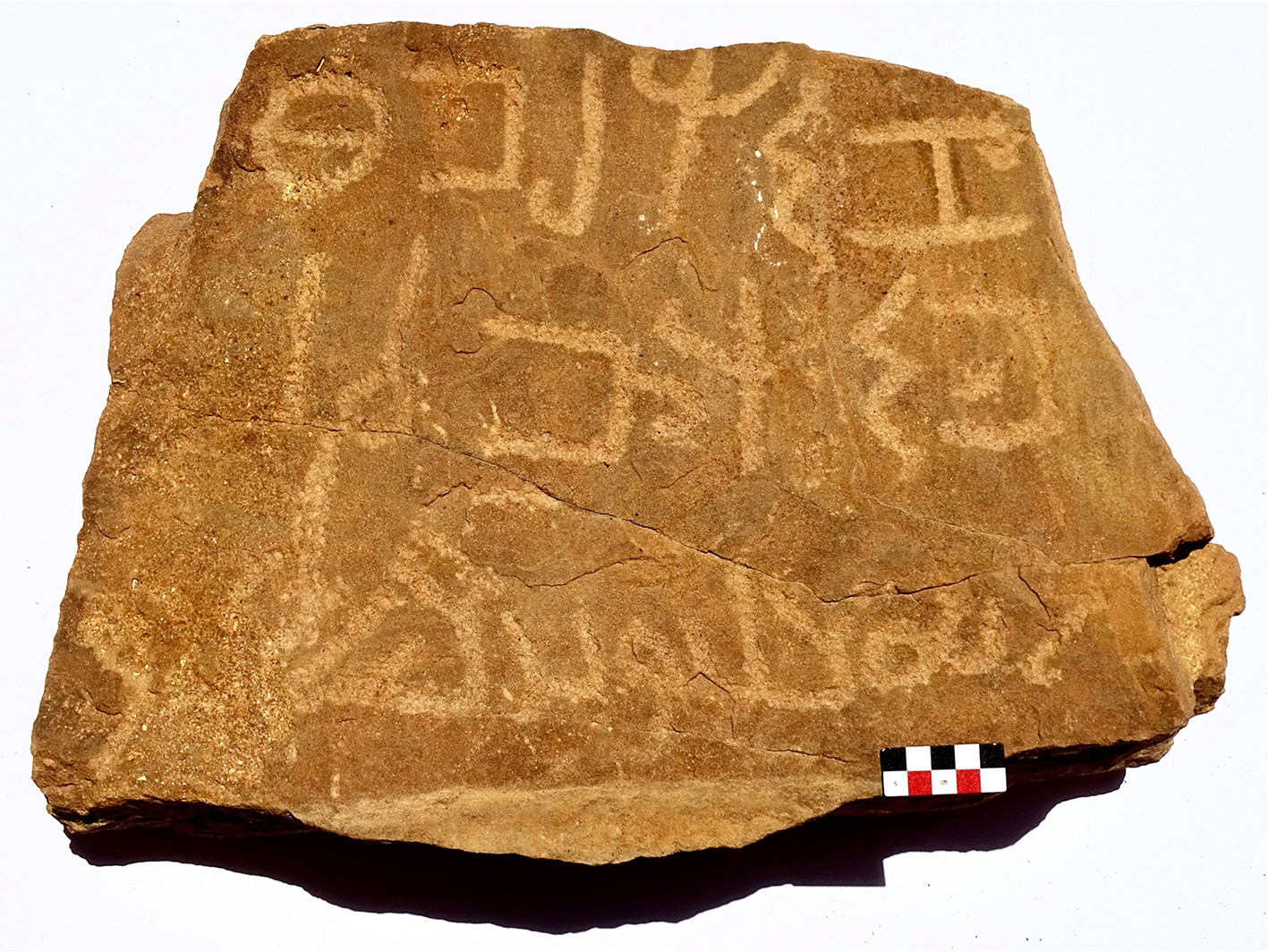
Thamudic D
ʾn klbw bn ks¹yr
Transliteration of the inscription designated Tham 1.
Nabataean-Arabic writing
ʾnh klbw br ksyrw
Transliteration of the inscription designated NabAr 1.
Both inscriptions repeat a similar sequence: a personal name, followed by the kinship term “son,” and then the name of another person. Their content can be rendered provisionally as “I am Klbw, son of Ksyr/Ksyrw.” The spelling of individual elements differs, making these inscriptions useful for comparing graphic forms and ways of representing linguistic material.
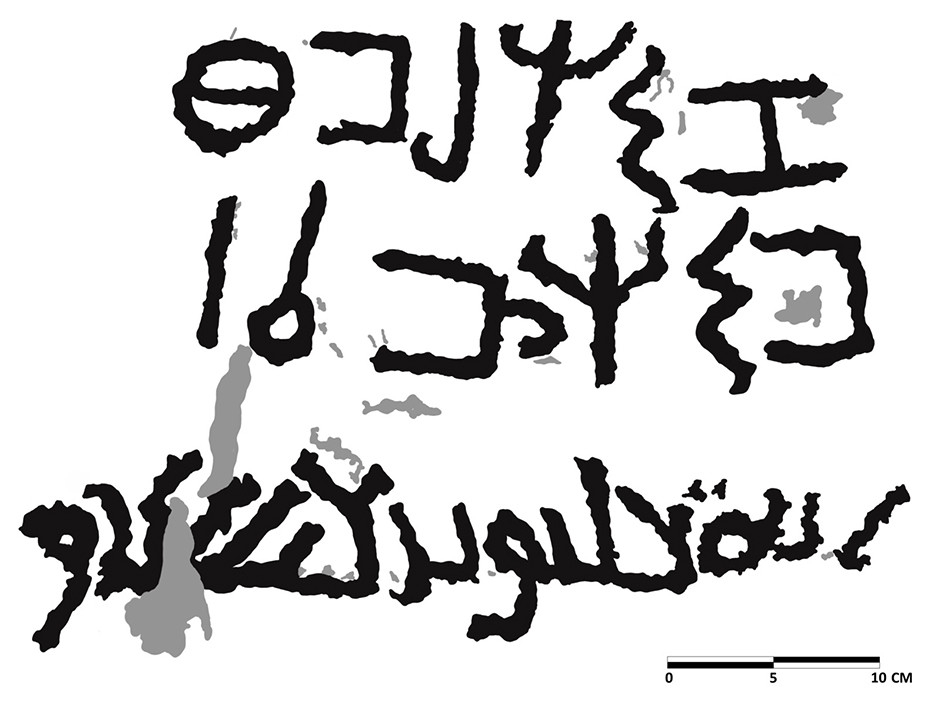
Such examples matter not only as evidence for linguistic history. They also allow us to investigate the act of writing itself: which elements are retained, which are represented differently, and how consistently the same components of a formula are transmitted. When working with these materials, the original inscription, transliteration, and interpretation should be recorded separately so that observed graphic features are not conflated with analytical readings.
For further verification, consult inscription catalogues and publications that provide images, transliterations, and information about the discovery context. The OCIANA — Online Corpus of the Inscriptions of Ancient North Arabia catalogue is particularly useful.